
What if There’s Coliform Bacteria in Your Well Water?
A positive coliform test means your well water could be contaminated and should not be assumed safe to drink until you confirm and fix the problem. Coliform bacteria are a warning light, not usually the disease itself, but their presence tells you that a path exists for harmful germs to get into your water.
If you own a private well in central North Carolina, this matters: roughly one in four NC residents drinks from a private well, and no one tests that water but you.
At Q&A Home Inspections, we help Triad-area homeowners and buyers understand their results. This guide explains what coliform bacteria are, how they get in, the health risks, how to test, and how to get rid of them.
What Is Coliform Bacteria, and Why Does It Matter?
Coliform bacteria are a large group of microorganisms that live in soil, plants, surface water, and the digestive tracts of animals. Most are harmless on their own.
Labs test for them because they work as an indicator organism: if coliform can reach your well, then disease-causing pathogens can probably reach it too. That is why a positive result matters even when you feel fine.
Water that looks clear and tastes normal can still be contaminated, because bacteria are invisible to your eyes, nose, and tongue. The only way to know is with a lab test.
The CDC recommends testing private wells at least once a year, and you can read its full guidance in the CDC’s guidelines for testing well water.
Total Coliform vs. Fecal Coliform vs. E. coli
Not all coliform results carry the same risk. Here is how the three terms differ:
| Result | What it is | What it means for you |
|---|---|---|
| Total coliform | The broad indicator group includes soil, plants, and surface water | A path for contamination exists. Often, an environmental entry point like a cracked casing, not necessarily waste |
| Fecal coliform | The subset that comes from the gut of warm-blooded animals | Higher concern: waste from animals or septic systems may be reaching the well |
| E. coli | A specific member of the fecal group | Confirms recent fecal contamination and the highest risk. Stop drinking the water |
A standard test flags whether E. coli is present, but it does not identify dangerous strains by name. Treat any E. coli positive as a stop-drinking signal until the water is disinfected and retested.
How Coliform Bacteria Get Into a Well
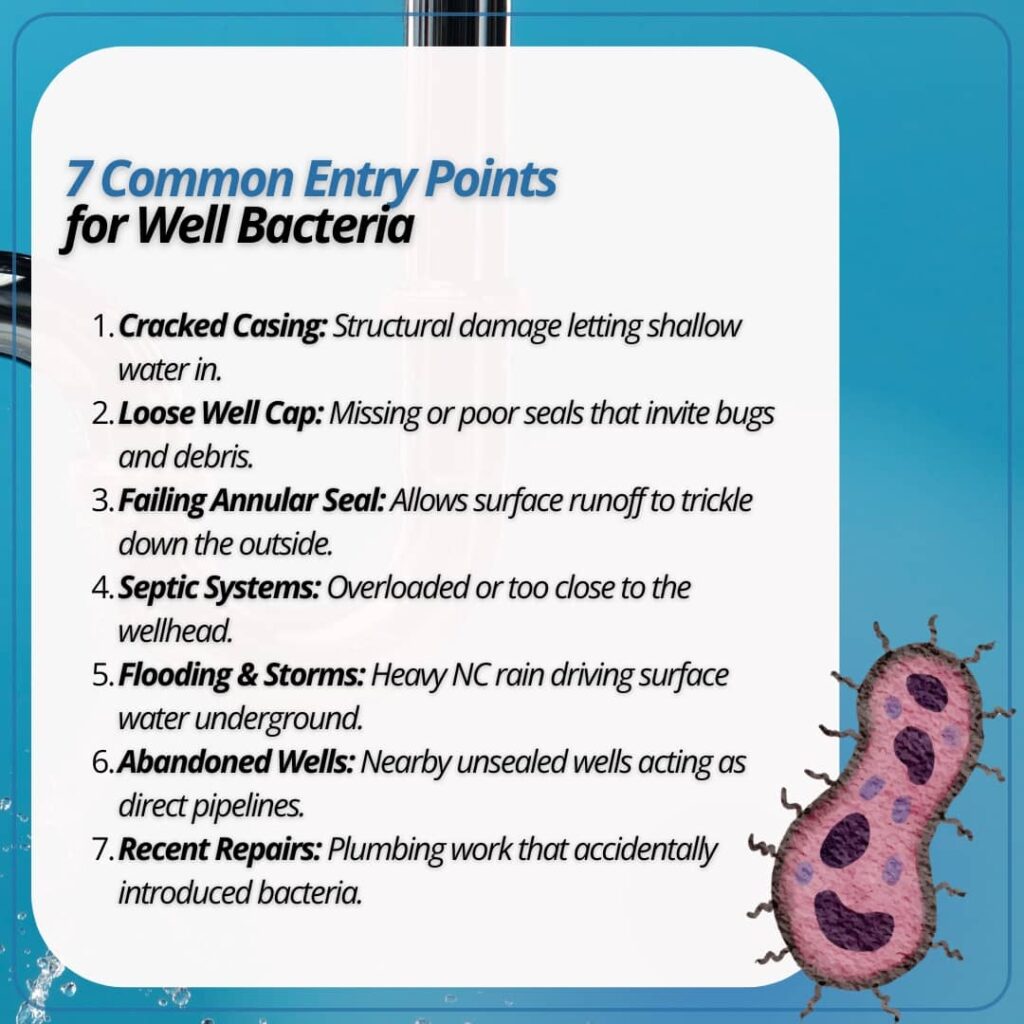
Coliform usually enters a well through a physical opening rather than the deep aquifer itself. Finding that opening is the key to fixing the problem for good. Common entry points include:
- A cracked or damaged well casing.
- A loose, missing, or poorly sealed well cap that lets insects, surface water, or debris in.
- A failing annular seal around the casing that lets shallow groundwater run down the outside of the well.
- Nearby septic systems, especially a failing drainfield. Understanding how a septic drainfield works helps explain why a tank too close to a well becomes a contamination risk.
- Surface water and runoff after heavy rain or flooding, which is common after North Carolina’s storm seasons.
- Abandoned wells nearby act as a direct channel to groundwater.
- Recent plumbing or pump repairs that introduced bacteria into the system.
Because so many causes involve standing water and moisture, the same conditions that contaminate a well often show up elsewhere on a property. Persistent groundwater problems, like water in a crawl space, point to drainage issues worth addressing around the home.
Is Coliform in Well Water Dangerous?
Coliform itself is usually not dangerous, but it can signal water that may make you sick, so it should never be ignored. When fecal coliform or E. coli is present, drinking the water can cause gastrointestinal illness with symptoms like diarrhea, cramps, nausea, and vomiting. These symptoms are not unique to waterborne illness, so do not rely on how you feel to judge safety.
Some people face higher risk and should be especially cautious until the water is confirmed safe:
- Infants and young children.
- Older adults.
- Pregnant women.
- Anyone with a weakened immune system.
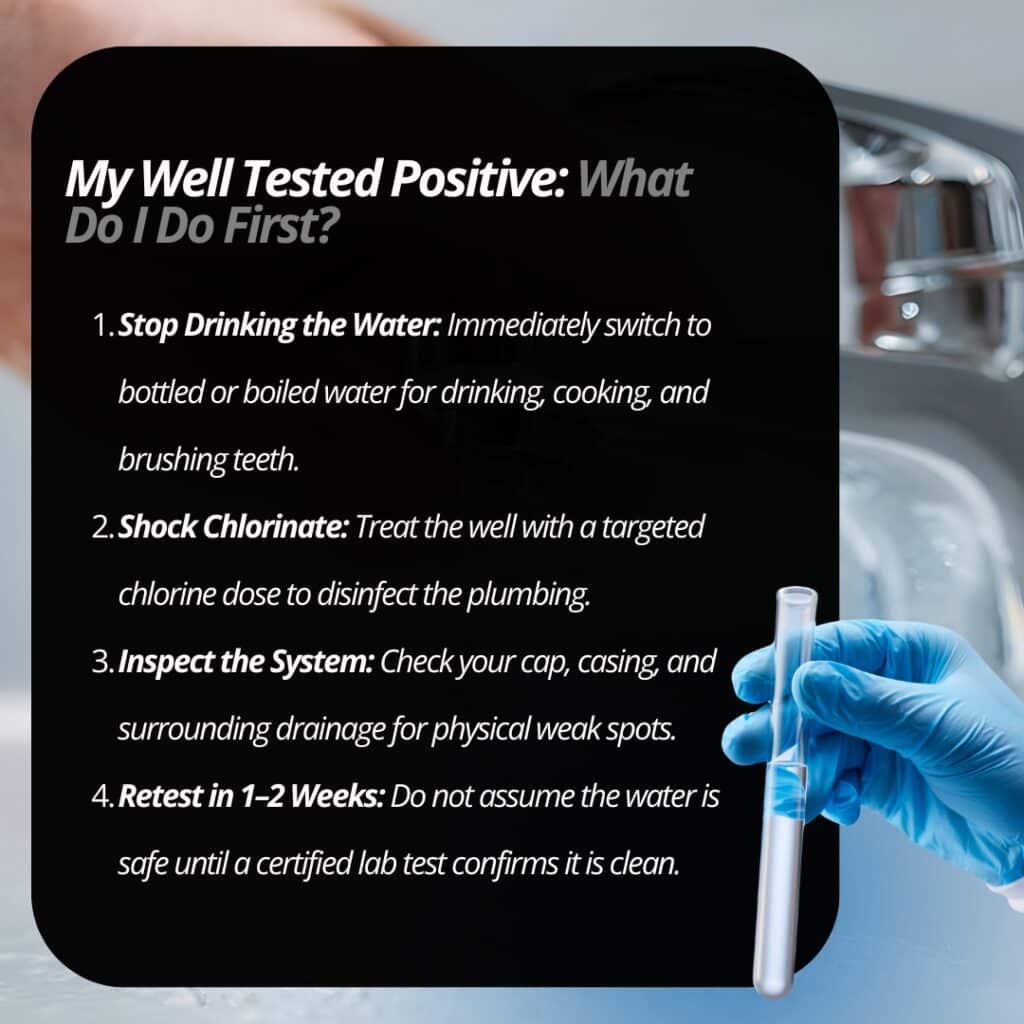
If your test comes back positive, switch to bottled or boiled water for drinking and cooking until you have disinfected the system, and a follow-up test comes back clean.
How to Test Your Well Water for Bacteria
The reliable way to test for coliform is a sample analyzed by a state-certified laboratory, not a hardware-store dip strip. Professional testing follows clean sampling procedures, which matters because a sloppy sample can show bacteria that came from the faucet, not the well.
North Carolina has specific rules and resources for well owners:
- Since 2008, every newly constructed private well in NC must be tested for bacteria, nitrates, and other contaminants within 30 days of completion.
- Testing is coordinated through your county health department, which can sample through the NC State Laboratory of Public Health or a certified commercial lab.
- The state recommends testing for total and fecal coliform every year, with heavy metals and nitrates every two years.
You can review the state’s recommendations in the NCDHHS private well water testing FAQs. Beyond the annual schedule, retest any time the water changes in taste, color, or smell, after any flooding, and after well or pump repairs. Water quality is one of several invisible risks worth checking, alongside testing for safe radon levels in a home, so many buyers bundle the two.
How to Get Rid of Coliform Bacteria in Well Water
The first step in fixing coliform is to disinfect the well, then find and repair the entry point so it does not come back. The standard one-time fix is shock chlorination, but recurring contamination usually needs a permanent treatment system.
Your options compare like this:
| Treatment | Best for | Notes |
|---|---|---|
| Shock chlorination | A one-time positive result | Disinfects the well and plumbing. Will not stop contamination if the source is not repaired |
| Continuous chlorination | Ongoing low-level contamination | Adds a controlled dose; requires equipment and upkeep |
| UV disinfection | Killing bacteria without chemicals | Effective on clear water; needs filtration first if the water is cloudy |
| Reverse osmosis (point of use) | Drinking-water tap safety | Treats water at one tap, not the whole house |
A basic shock chlorination follows these steps:
- Calculate the chlorine dose based on your well depth and diameter.
- Mix and pour the chlorine solution into the well.
- Circulate it through every faucet until you smell chlorine at each one.
- Let it sit, usually 12 to 24 hours, without using the water.
- Flush the system, then retest after a week or two to confirm the bacteria are gone.
If a well keeps testing positive after shock chlorination, the source has not been fixed, and you should bring in a licensed well contractor to inspect the casing, cap, and seal.
Related Questions to Explore
Is coliform in well water dangerous?
Coliform itself is usually harmless, but it signals that pathogens could be entering your water, so the water should not be considered safe to drink until you confirm and treat it. A positive E. coli result is the greatest concern and means you should stop drinking the water immediately.
What is the difference between total coliform and E. coli?
Total coliform is the broad indicator group found in soil and surface water, while E. coli is a specific member of the fecal group that confirms recent contamination from waste. A total coliform positive usually points to an environmental entry path, while an E. coli positive points to fecal contamination and a higher risk.
Can you shower in water with coliform bacteria?
In most cases short showers are low risk for healthy adults, since the main danger is swallowing the water. Be careful not to swallow it, keep it away from open cuts, and take extra caution with infants, the elderly, and anyone with a weakened immune system until the water is treated.
How often should I test my well water for bacteria?
At least once a year for total and fecal coliform, which both the CDC and NCDHHS recommend. Also, retest after flooding, after any change in taste, color, or smell, and after repairs to the well or pump.
Does boiling water kill coliform bacteria?
Yes, bringing water to a rolling boil for at least one minute kills coliform and most other bacteria, which is why a boil-water step is a good short-term measure. Boiling does not remove nitrates, lead, or chemicals, so it is a stopgap, not a substitute for disinfecting and treating the well.
When to Call a Professional
If your well tests positive for coliform, especially E. coli, or keeps testing positive after disinfection, it is time to bring in professionals. Reliable testing through a certified lab and a licensed well contractor for repairs will tell you whether the problem is a one-time event or a structural issue with the well.
Q&A Home Inspections is an InterNACHI-certified, veteran-owned company serving Greensboro and the entire Triad, including Davidson and Randolph counties.
We help buyers and homeowners get a clear picture of their water, radon, and overall home condition before small risks become serious problems. To get your well water checked, you can learn about our water testing services or see the areas we serve and reach out.
Conclusion
A coliform result is a signal to act, not a reason to panic. Keep these takeaways in mind:
- Coliform is an indicator that contamination can reach your well; E. coli means stop drinking the water now.
- Test annually through a certified lab, and retest after floods, repairs, or any change in your water.
- Shock chlorination handles a one-time problem, but repeat positives mean the well needs repair.
If you own a private well in central North Carolina, regular water testing is the simplest way to protect your household. Reach out to Q&A Home Inspections and we will help you understand exactly what is in your water.