
What Is Considered a Safe Radon Level in a Home?
The short answer: No level of radon exposure is completely risk-free. While the EPA recommends taking action when indoor radon reaches 4 pCi/L (picocuries per liter) or higher, any exposure carries some degree of risk.
If you just received a test result, or you are preparing to buy or sell a home in North Carolina, this guide explains what the numbers mean, when to act, and how Q&A Home Inspections, LLC can help you protect your household.
What Is Radon and Why Does It Matter?
Radon is a radioactive gas that forms naturally when uranium in soil and rock breaks down. It seeps up through the ground and can concentrate inside homes to dangerous levels.
You cannot smell it, see it, or taste it. Radon is the second leading cause of lung cancer in the United States, responsible for about 21,000 deaths each year, according to EPA radon health risk guidelines.
Most people do not think about radon until a home inspection or a real estate transaction brings it up. The good news is that testing is straightforward and mitigation works.
Inspector Insight: We routinely see homes with no visible issues test above the EPA action level. A clean, newer home can still have elevated radon—testing is the only way to know.
How Radon Is Measured
Radon levels are measured in picocuries per liter, abbreviated pCi/L. A picocurie is a unit of radioactivity.
In the United States, the EPA uses pCi/L as its standard measurement. Some international sources, including the World Health Organization (WHO), use becquerels per cubic meter (Bq/m3). The conversion is simple: 1 pCi/L equals roughly 37 Bq/m3.
The average indoor radon level in the U.S. is about 1.3 pCi/L. The outdoor average is about 0.4 pCi/L.
What Do Different Radon Levels Mean for Your Home?
Here is a straightforward breakdown of radon level ranges and what each one means:
|
Radon Level (pCi/L) |
Category |
Recommended Action |
|---|---|---|
|
Below 2 pCi/L |
Low |
Continue monitoring; no immediate action required |
|
2 to 4 pCi/L |
Moderate |
EPA says consider mitigation; WHO recommends a residential reference level of 2.7 pCi/L when feasible. The WHO recommends a residential reference level of 2.7 pCi/L (about 100 Bq/m³) when feasible. |
|
4 pCi/L and above |
Action level |
EPA recommends mitigation promptly |
|
8 pCi/L and above |
Elevated |
Prioritize mitigation immediately |
This range falls below both the EPA and WHO action thresholds. The health risk at this level is considered low, but it is not zero. Continued monitoring is a good idea, especially in older homes or homes with basements.
Between 2 and 4 pCi/L
This is the gray zone. The EPA acknowledges this range as something to consider for mitigation, particularly if you smoke. The WHO recommends acting at 2.7 pCi/L (100 Bq/m3). If your result falls here, a second or long-term test is a worthwhile step before deciding whether to mitigate.
4 pCi/L and Above
The EPA urges homeowners to fix their homes when radon reaches 4 pCi/L. Long-term exposure at elevated levels increases lung cancer risk over time, especially for smokers. Fortunately, professionally installed systems are highly effective and can significantly reduce radon levels—sometimes by up to 99%.
Why Radon Levels Change Over Time
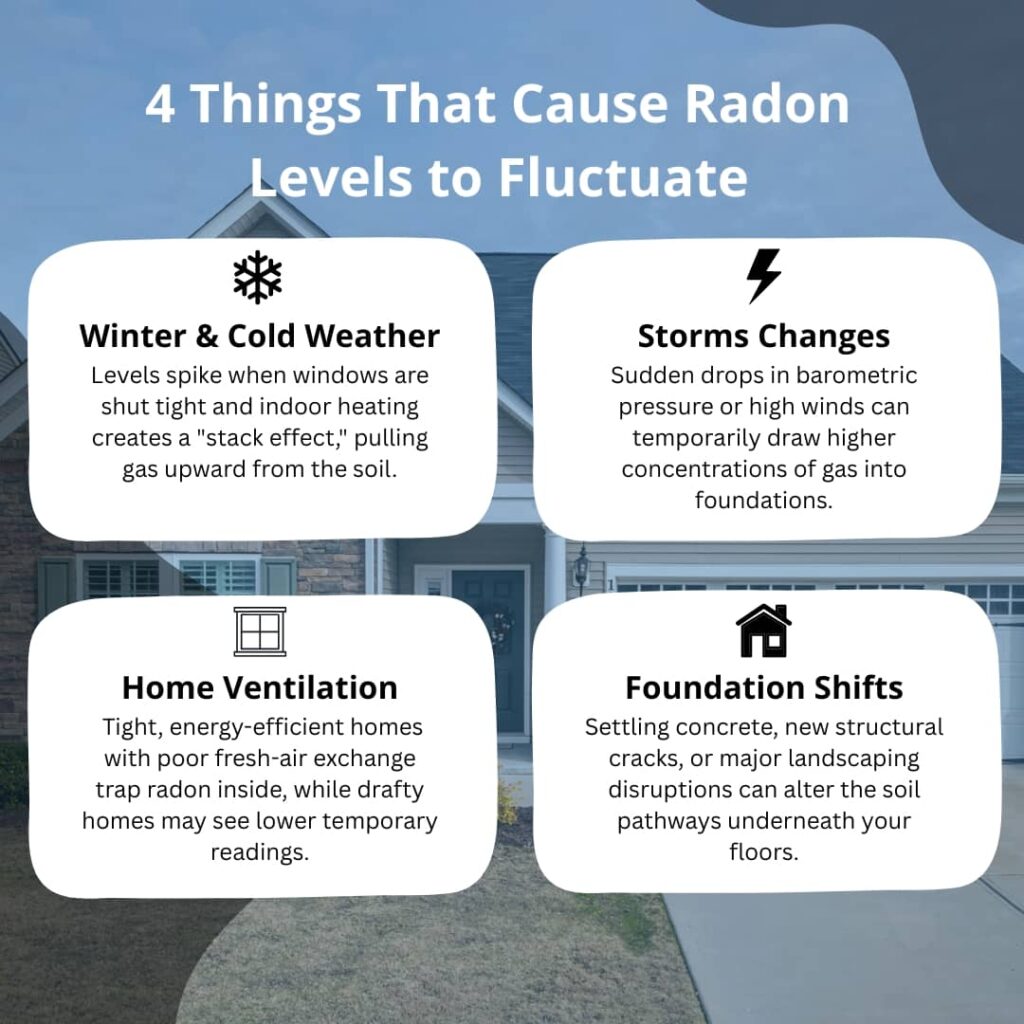
Radon is not constant inside a home. Several factors cause levels to rise and fall:
- Season: Levels tend to be higher in winter, when homes are sealed, and ventilation is reduced. Testing during closed-house conditions often captures higher radon levels and is commonly used during real estate transactions, though long-term testing provides the best picture of year-round exposure.
- Weather: Storms, barometric pressure shifts, and high winds can temporarily spike indoor radon.
- Ventilation: Homes with better air exchange generally measure lower levels.
- Foundation condition: New cracks, settled slabs, and disturbed soil around the home can change how much radon enters.
This is why a single short-term test run over 48 to 96 hours is not always definitive. A long-term test, run over 90 or more days, gives a more reliable picture of your home’s annual average radon exposure.
How Radon Gets Into Your Home
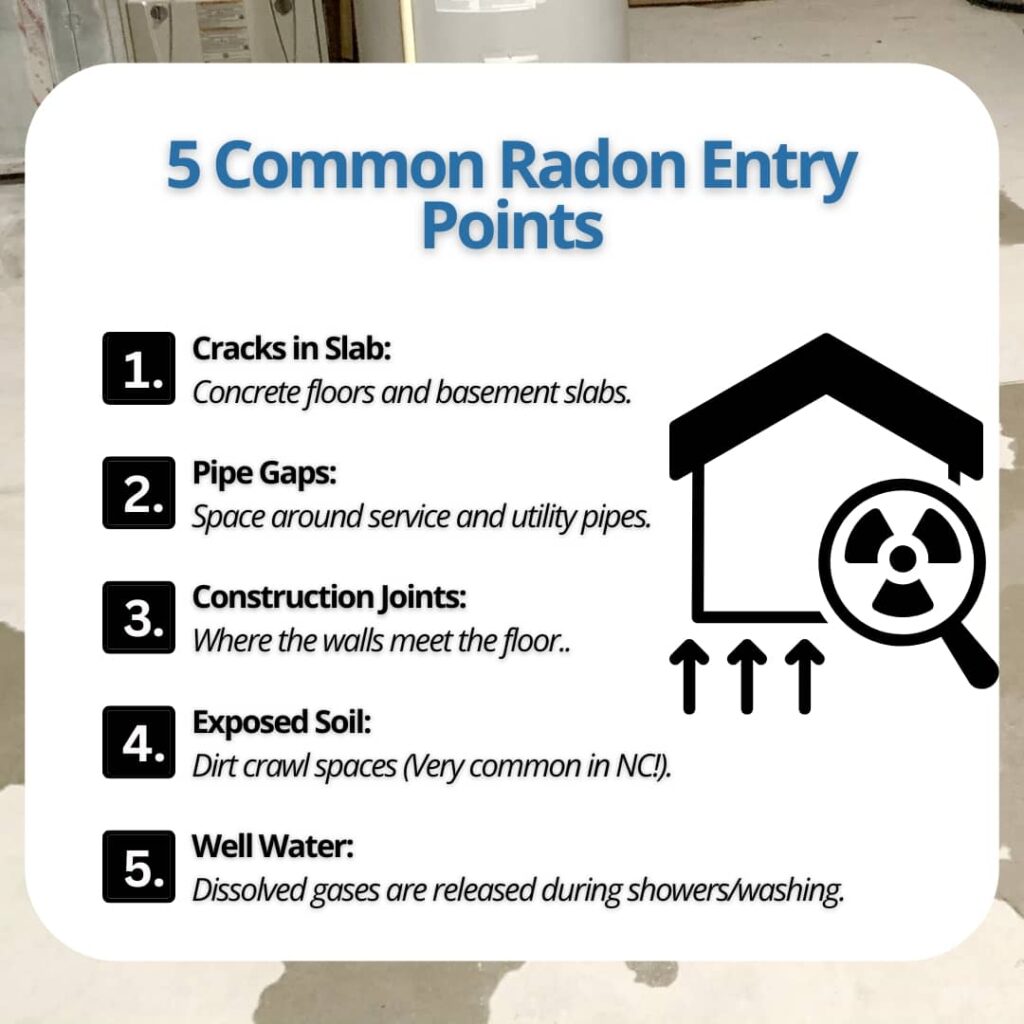
Radon rises from uranium-bearing soil and rock, and it enters homes through:
- Cracks in concrete slabs and floors
- Gaps around service pipes
- Construction joints
- Crawl spaces with exposed soil floors
- Well water (in some cases)
Certain areas of North Carolina, especially parts of the Piedmont and mountain regions, regularly test above EPA action levels, making radon testing an important consideration for homeowners.
The NC Radon Program at NCDHHS monitors indoor radon across the state, and testing data show many NC counties, particularly in the Piedmont and mountain regions, consistently measure indoor radon above the EPA action level.
The granite and metamorphic rock formations under this part of the state concentrate uranium in the soil. If you own a home in the Triad area, radon testing is not just a precaution; it is a practical priority.
Radon Testing: Short-Term vs. Long-Term
Two main types of tests are used in homes:
- Short-term tests (48 hours to 90 days). A charcoal canister or electret ion chamber is placed in the lowest livable level of the home for two to four days. These tests are common in real estate transactions because they provide a quick result. A short-term test is a good starting point, but weather and ventilation on those specific days can influence the reading.
- Long-term tests (90 or more days). An alpha track detector stays in the home for at least 90 days. This gives a more reliable annual average and is better for ongoing monitoring or when a short-term result lands in the 2 to 4 pCi/L gray zone.
A certified professional, like the team at Q&A Home Inspections’ radon testing service, uses calibrated devices and follows EPA-recommended protocols to produce a result that is accurate and defensible: particularly important when radon testing is part of a real estate transaction.
Inspector Insight: During real estate transactions, short-term radon tests are common because buyers need answers quickly. If results are borderline, long-term follow-up testing often provides additional clarity.
Common Radon Myths
- Myth: “If my neighbor doesn’t have radon, I’m fine.”
- Reality: Not necessarily. Radon levels can vary dramatically between homes—even those built side by side.
- Myth: “Only old homes have radon issues.”
- Reality: False. New construction and historical homes alike can test well above safety thresholds.
- Myth: “I don’t have a basement, so I don’t need to test.”
- Reality: Radon can easily accumulate in slab-on-grade homes and crawl spaces, affecting the air quality of the main living areas above.
How to Reduce Radon Levels in Your Home
If testing shows elevated levels, mitigation is the answer. The most effective approach is sub-slab depressurization (SSD), also called a soil suction system. A licensed mitigation contractor:
- Installs a PVC pipe through the foundation slab
- Connects it to a fan that draws radon-laden air from beneath the slab
- Vents the gas safely above the roofline, away from windows and entry points
Other mitigation approaches include:
- Crawl space encapsulation and ventilation for homes with exposed dirt crawl spaces
- Block wall depressurization for basements with hollow block walls
- Sealing cracks and gaps as a supplemental measure (not a standalone fix)
- Increased mechanical ventilation for mild cases with good structural access
Mitigation costs typically range from $800 to $2,500, depending on home size, location, and construction type. After a system is installed, a follow-up test confirms it is working.
Related Questions to Explore
Is a radon test included in a standard home inspection?
No, a standard real estate inspection focuses primarily on the visible structural, mechanical, and electrical components of a house. Because radon is an invisible gas requiring specialized diagnostic equipment, it is typically performed as an optional, add-on environmental testing service.
Can radon or other hazardous materials enter a home through the water supply?
Yes, radon can dissolve into groundwater and escape into the air when water is used for showering or washing dishes. For homes relying on private wells, pairing an air test with comprehensive water testing ensures that dangerous levels of minerals, bacteria, or dissolved gases are caught early.
How does the condition of a crawl space impact indoor air quality?
Since much of the air in a home rises from the lowest level, an unsealed or damp foundation can negatively affect your living space. Routine crawl space inspections help identify structural cracks, open soil, and moisture issues that allow radon gas, pests, and high humidity to seep into the rooms above.
What other hidden environmental risks should buyers look for when purchasing a property?
Beyond radioactive gases, poor ventilation and hidden leaks can trigger significant indoor air quality issues. Professional mold testing is highly beneficial during a real estate transaction to ensure the property is free from hidden toxic spores, particularly in basements, kitchens, and bathrooms.
When to Call a Radon Testing Professional
DIY test kits from hardware stores can give you a general idea of your home’s radon level. But there are situations where a certified professional is the better choice:
- Real estate transactions. Buyers and sellers need a test result that will hold up to scrutiny. A professional inspection with calibrated equipment is the standard. The NC Real Estate Commission’s continuing education curriculum reinforces this expectation for agents and buyers alike.
- Result above 4 pCi/L. A certified inspector can confirm the result with a follow-up test and guide you through selecting a qualified mitigation contractor.
- Result in the 2 to 4 pCi/L range. A professional long-term test is more reliable than a DIY short-term kit if you want a confirmed annual average.
- Post-mitigation verification. After a radon reduction system is installed, a third-party test confirms it is performing as expected.
Q&A Home Inspections, LLC serves Greensboro, NC, and all of the Triad. Maurice Quick is InterNACHI-affiliated and trained to conduct certified radon tests that meet EPA protocol standards.
For a full picture of your home’s health, pair your radon test with our home inspection services.
Key Takeaways: What to Know About Safe Radon Levels
The question “what is a safe radon level” does not have a clean answer because no level is technically safe. What matters is where your home falls relative to the EPA’s action threshold:
- Radon at 4 pCi/L or above: take action
- Radon between 2 and 4 pCi/L: consider a long-term test and weigh mitigation, especially if you smoke
- Radon below 2 pCi/L: lower risk, but continued monitoring is worthwhile
North Carolina has a significant radon risk, particularly in the Piedmont and mountain regions. Testing is the only way to know your home’s actual level.
Whether you are buying a home, selling one, or simply want peace of mind, radon testing gives you real answers about an invisible risk.
At Q&A Home Inspections, we provide professional radon testing throughout North Carolina using calibrated equipment and established testing protocols—so you get results you can trust.
Because when it comes to radon, guessing is never the right answer.